Your gym friend keeps mentioning macros. Your colleague has a shaker on her desk. And you've walked past those giant tubs of powder at the pharmacy a dozen times without knowing if any of it applies to you.
It does. That's what this article is for.
Protein is probably the most talked-about nutrient in health and fitness and also the most misunderstood by anyone who isn't already deep into fitness culture. The word gets attached to gym equipment, bodybuilding competitions, and people drinking chalky shakes after workouts. None of which sounds particularly relevant to your life.
But protein has nothing inherently to do with gyms. It's a macronutrient one of the three main categories of nutrients your body runs on, alongside carbohydrates and fats. And it's the one that most Malaysians are consistently not getting enough of, regardless of whether they exercise.
What protein actually does
Think of protein as your body's construction material. Every cell in your body in your skin, your muscles, your organs, your hair, your immune system is built from proteins. When cells get damaged or worn out, your body repairs and replaces them using amino acids, which come from the protein you eat.
But it doesn't stop at physical structure. Protein is also the building block for enzymes (which drive every chemical reaction in your body), hormones (which regulate everything from metabolism to mood), and neurotransmitters (which are what your brain uses to think, feel, and function).
In other words:
protein isn't a fitness supplement. It's a fundamental requirement for your body to work properly.
Why most Malaysians aren't getting enough
Malaysian cuisine is built around carbohydrates. Rice is the foundation of most meals. Noodles, bread, and roti fill the rest. Protein shows up in the fish, the chicken, the tofu, the eggs but usually as a side character, not the main dish. A roti canai breakfast: about 8 grams of protein.
Economy rice lunch with one dish: around 20 grams.
Dinner at home with shared dishes: maybe another 20.
Total for the day: roughly 50 grams.
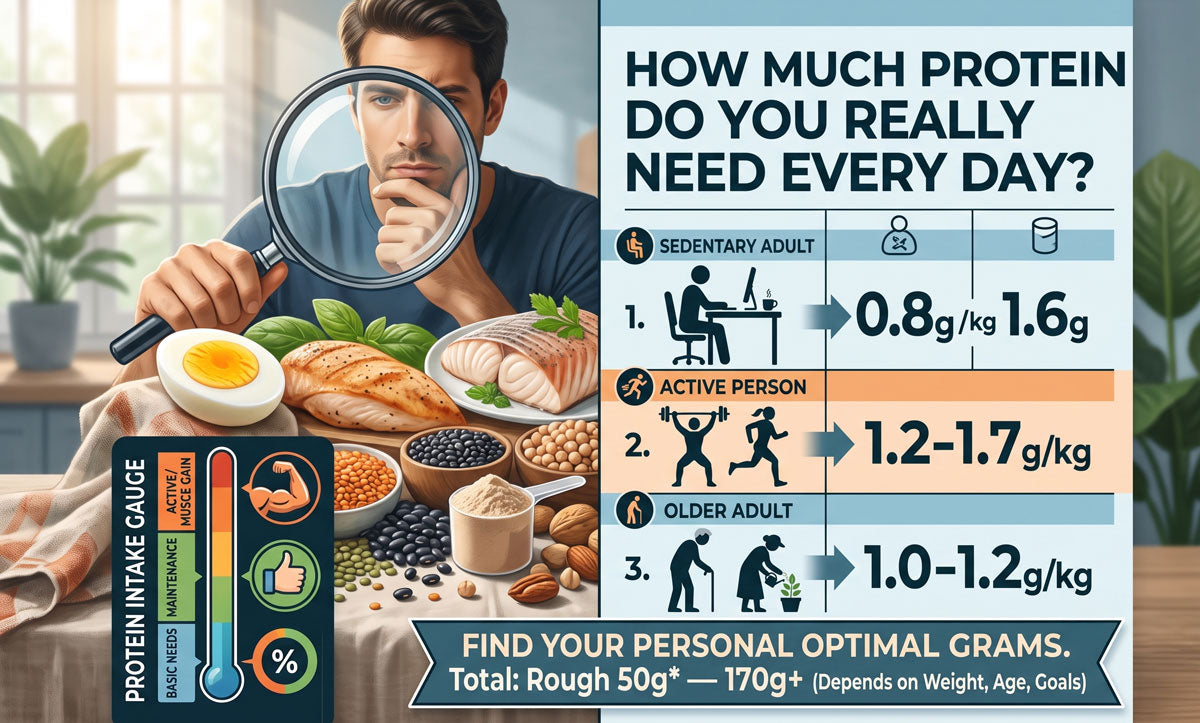
The general recommendation for a sedentary adult is 0.8 grams per kilogram of bodyweight so about 56 grams for a 70kg person. For anyone who's active, stressed, recovering from illness, or just trying to maintain their body well as they get older, that target is significantly higher.
Many Malaysians are right at the bare minimum or below it without realising anything is wrong.
So do you need a protein supplement?
Honestly, not necessarily. If you can consistently eat high-quality protein at every meal eggs, fish, chicken, tofu, tempeh, dairy you may be fine without supplementation.
The problem is that most people can't do that consistently. Work gets busy. You skip breakfast. Lunch is whatever's near the office. Dinner is takeaway. On those days — which for most working Malaysians is most days a protein supplement is genuinely useful.
Think of it the same way you think about a multivitamin: not a replacement for good food, but a reliable way to close a gap that your lifestyle makes hard to fill through food alone.
If you do try a protein supplement, here's what to look for
Walk into any supplement store and you'll be presented with 50 options. It is overwhelming. Here's the simple version.
Whey protein is the most studied and most straightforward.
It's derived from milk during cheese-making. It's absorbed quickly, it's complete (meaning it contains all the amino acids your body can't make itself), and it's well-supported by decades of research. For most people who tolerate dairy, it's the best starting point.
If you're lactose-sensitive, try whey isolate or a plant-based protein or clear.
Whey isolate has most of the lactose removed and is gentler on digestion. Plant-based proteins (usually pea and rice blended together) are dairy-free and increasingly good in terms of taste and amino acid profile.
Check for halal certification.
In Malaysia, look for JAKIM halal certification on the label. Wolves Fitness products are JAKIM-certified.
Two scoop a day is enough to start.
You don't need to take it twice a day or follow a complicated protocol. One serving, in water or low-fat milk, once a day — ideally at a time when you know your food protein will be low (usually breakfast or mid-afternoon) is a meaningful addition to your nutrition.
Where to start if you're completely new to this
The first thing to do is just pay attention to your food for three days. Look at what you're actually eating and roughly estimate whether you have a protein source at every meal. Most people are surprised.
If you're consistently missing protein at breakfast or relying on snacks instead of proper meals, that's where to start before you buy anything.
If you're eating well but know your protein is still low (which is true for most Malaysians), then a basic protein supplement is a practical, low-effort way to close the gap.
Start simple. See how you feel. Adjust from there.
→ See Wolves Fitness beginner-friendly protein range